








All the Wild Horses
Snowy Brumby Horsemanship is located on the banks of the Snowy River on country that has both inspired poetry and Australian legend. Wedged between the Snowy Mountains and the vast Monaro Plains, it is a land that is no stranger to drought and flooding rain, nor to storytelling, dashed dreams, and change.

The story of Snowy Brumby Horsemanship starts with Claire Rogerson and her son Charlie, and “every brumby that came into our lives by accident.”


Summer training is wrapping up as the weather cools in the mountains. Visitors, under the careful tutelage of the team have worked daily, using a calm, consistent approach. Charlie, his girlfriend Tori “helps like all members of our family including my partner Richard when they can.” Though it is a dangerous job there are no whips or spurs in sight. “Most trainers use catch and control, then communicate. We do communicating from pure wild and that communicating can take up to a year before we get the first touch. But when we do, it’s a domino effect.”

“Once you learn their language their interest comes from communicating with you and thus their interest in you grows,” says Claire.

The drought has broken and there is plenty of food by the river but over a dozen inquisitive brumbies have made their way to the training area. In the round yard we find Darcy, who has arrived with some previous handling before help was sought. In the mountains, brumbies position one side of their body toward the lead mare for safety, and here Darcy turns one flank to the round yard fence. They live in family groups known locally as mobs – a community intrinsic to their survival. Central in their complex hierarchy is the lead mare, a role that Claire now draws on in training to gently apply pressure and re-engage the student. “Trainers learn to move like a brumby and communicate with them as they do to each other. It kind of looks like a dance and once done right you can then begin to train through partnership. Wild horses move in circles, and this is why we use a large round yard for this movement. The wilder the brumby the larger the round yard to be used.” As Darcy’s confidence grows, he follows her around the yard then lets her approach for a touch before bowing his head. Claire bows back.

The approach is “wild horse led” and unorthodox, and word has spread across the country. Brumbies have come from drought-stricken properties, others from local sales where they didn’t make abattoir money. Easy, Nifty, and Moody came from the Kosciuszko traps over three years ago, spared from subsequent culls. Some have come from the Bago traps, others, like Darcy have arrived for additional training. The team has since worked with over 100 wild horses, bringing them up to being safe to handle and training them for riding before going home to their owners.


It’s not that the old ways have completely disappeared though. In one of the most striking photos here, Charlie is seen riding Sammy through the mighty Snowy River in a Driza-Bone Riding coat. He’s only in his first few years of adulthood and has his own stock and horse transport and training business now. The world changes but fences still need building; stock need to be moved. Heritage is important up here, not as a relic to be treasured but rather as an action, like the tending of a fire. The work being done at SBH connects people, horses and the land – an intrinsic part of the cultural continuum of Australia. “We love the history of Driza-Bone. It is who we are and was made for what we do,” she says.
“It has also brought together experts to research and help develop further learnings of how we can use trained wild horses for weed control,” says Claire.
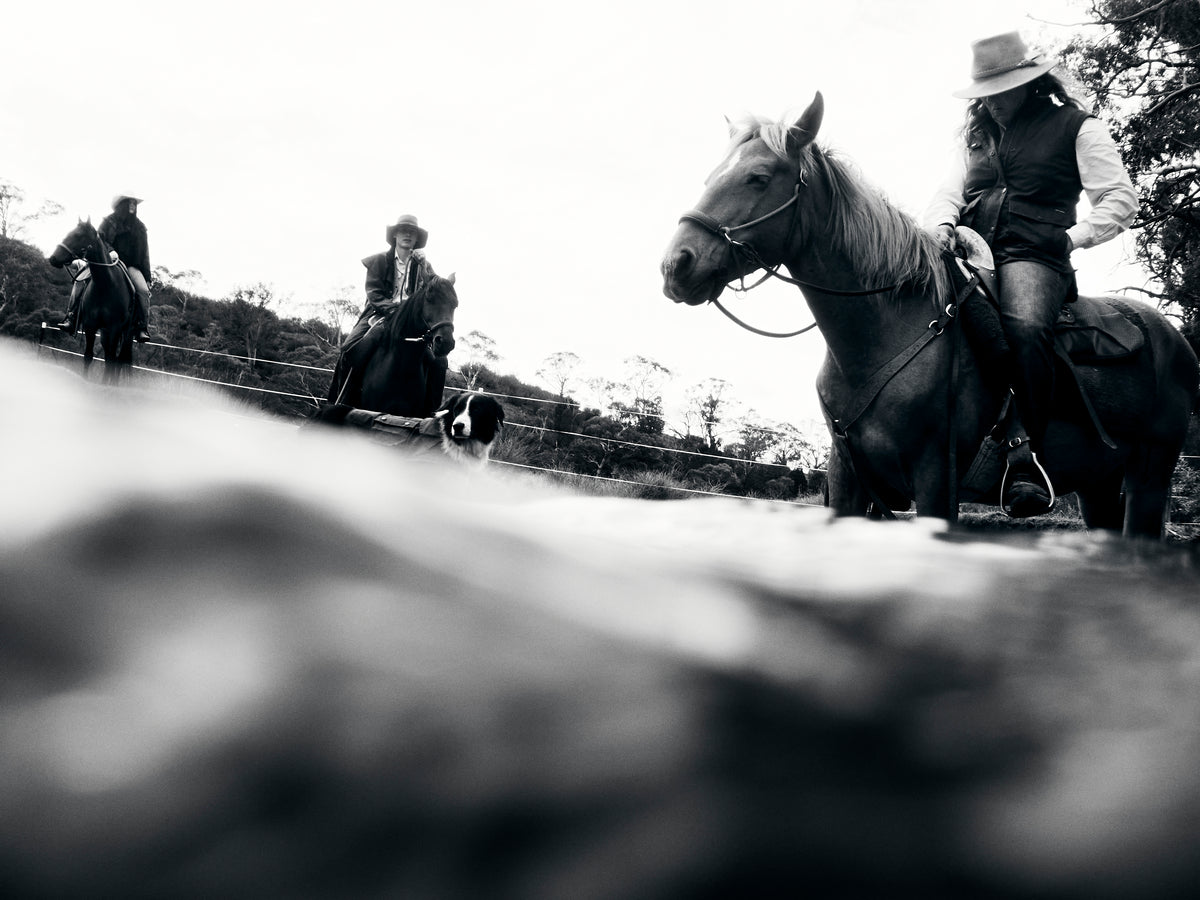
“The biggest part of this story is not me,” Claire insists. With the help of the charity’s president Sidonie Carpenter, SBH supports training work and brumbies in need of help. “It has also brought together experts to research and help develop further learnings of how we can use trained wild horses for weed control,” says Claire. Invasive plant species such as serrated tussock have proven to be successfully managed by brumbies.

Across the region, landholders and politicians are beginning to take notice – signing up for trials and watching closely. If working with brumbies is a circle, as Claire says, then this is where it widens. “Our world,” Claire says, “is to meet in the middle and try to be a voice for the once wild horse.” Drawing in landholders, researchers, and the community who are beginning to see these horses not as a problem to be solved, but as a legacy worth holding on to.
Charity members wear the heritage range


