Search

No results found for ""

Check your spelling or choose a more general keyword to get better results.

Continue shopping
New Autumn Winter Collection 2026

Popular Products

Rider Heritage Coat $499.00
Ranger Heritage Coat $479.00
Ladysmith Heritage Coat $479.00
Brookland Heritage Coat $499.00
A rustic interior scene with light wood walls and shelves holding ceramic pottery, with a large window showing an outdoor tree view. White overlaid text reads 'FATHER'S DAY - 5 MINUTE READ' and 'FELMARK POTTERY - JINDBYNE', plus the Driza-Bone Dogbone logo near the bottom.

Of Earth and Sky

When we first stepped foot on the property, I looked at the tall tussock and dry granite soil. A multitude of bush ants scurried about, unconcerned about our plans for stewardship. Climbing the hilly bushland knocked the air out of me. We are close to 1200m in elevation here, well over a kilometre higher than back in Melbourne. My husband and I took in the wildflowers, and the surrounding paddocks dotted with merino sheep, farm sheds, and twisted gums. It was ours now. A wedge-tailed eagle circled above; I waited for an ominous screech.

What were we doing building a pottery studio here? Jindabyne was a town that lived almost solely for ski tourism. In summers past, the shops seemed shuttered; the town dozing in hazy sunlight. Old Jindabyne sits drowned at the bottom of a Snowy Hydro dam. In a prolonged dry period, you can see the old church steps in the lake. Parts of the Snowy-Monaro are like the backdrop of an Australian gothic with their rock outcrops and eucalyptus die-back.

A split-screen collage showing a rustic collection of handmade ceramic tableware on a wooden table, and a warm interior room with wooden shelves displaying many ceramic vessels.
A man in a pottery workshop, shaping clay on a spinning wheel. He is wearing a dark navy quilted vest over an olive green shirt, with a white cloth around his waist.
My husband Andrei, working under his own name Andrei Davidoff Ceramics, had every success in the city making plates for high-end restaurants and teaching at an established pottery school.

But our modest backyard was struggling to accommodate the expanding ceramics production. Trestle tables were lined up outside the studio where ceramic pieces sat glittering in the sun after being sanded and washed.
A square art print featuring a top-down photograph of a circular, textured earthy brown surface, presented on a light beige background.

We needed space, but beyond that, working with clay tends to bring you up close to the elemental. The story of clay starts billions of years ago when the Earth was a mass of molten rock. Clay is essentially created by the breakdown of the Earth’s crust, decomposing through surface erosion, washed by rivers and rain over millennia. It is a product of the ‘grinding maw of geology’, as ceramic artist Daniel Rhodes put it in his 1973 book, ‘Clay and Glazes for the Potter’. A potter shapes this ancient matter into vessels and pieces which we then bring into our homes. We touch our lips to Earth when we sip that first morning coffee.

A split-panel collage showing handmade ceramic mugs on the left and a close-up of hands shaping clay on a pottery wheel on the right, set against a light beige background.

With the move, landscape soon began to inform the pieces that came off the pottery wheel. Andrei’s work took on the hues around us; burnt umber mugs, speckled finishes that resembled the granite tors, glazes mixed from eucalyptus ash that fire olive green.

A collection of handmade ceramic mugs and small pottery vessels displayed on wooden shelves in a warm, rustic setting.
And soon, every corner of our block felt like a discovery or a small miracle. The first eggs our chickens laid felt like Easter morning. Still warm, I pocketed the eggs and let them heat my hands in the Snowy Mountains morning.

Time was slow and thoughts were hopeful. We wanted to be part of the good things the Earth could give us. Blackberries, pine mushrooms, long walks, slow Sundays. We collected apples from feral trees on the roadside and made cider. Our daughters, always horse-mad, started riding lessons and I entered the fray.
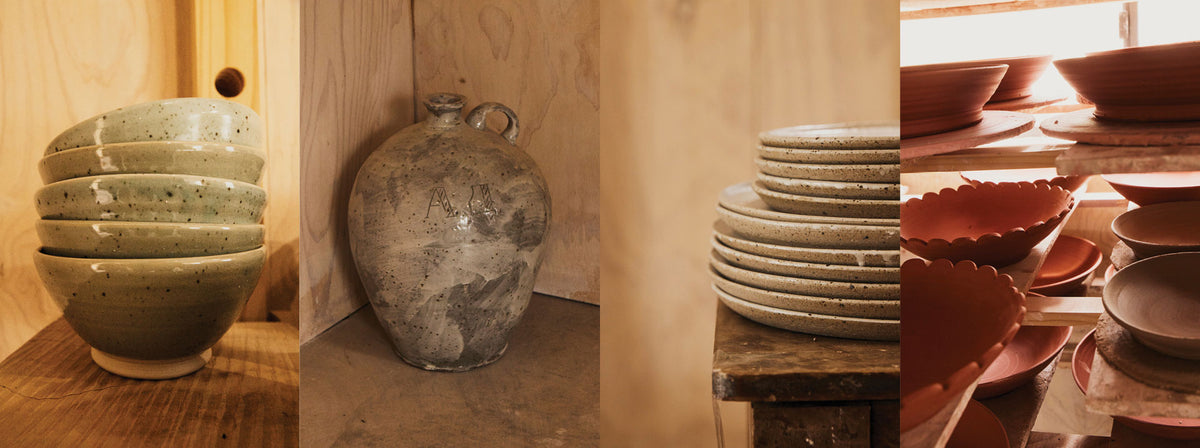
A four-panel collage showcasing handmade ceramic pottery, including stacked bowls, a rustic jug, a stack of plates, and terracotta-colored bowls, displayed in warm wooden interiors.
A woman with shoulder-length brown hair sits smiling on a wooden workbench inside a pottery or ceramic workshop. She is wearing the Driza-Bone Women's Lumberjack Jacket over a dark top and a white plaid skirt.
Quickly, my wardrobe of city staples – black silk, woollen coats, and sneakers – became redundant. I needed clothing that wouldn’t snag on barbed-wire or a tree branch. Clothing that wind from the ranges wouldn’t howl through and lucerne wouldn’t stick to.

Between recycling clay and crawling on the floor of a shed to take photos of the ceramics Andrei produced – I started scouring marketplace for second-hand Driza-Bone vests and jackets. While at the pub one night, I noticed my neighbour, a former bronco rider, had the same vintage yellow-tan Grosvenor jacket as me.

There is a process of shedding - of the old self and of expectations - when you find yourself in a rural setting.

A rustic interior scene with stacked ceramic plates on a table in the foreground and shelves with pottery on the left, framed by a large window looking out onto a tree-filled outdoor landscape.
The pottery build was delayed endlessly due to an uncommonly wet year; pouring the concrete slab was dicey to say the least. The pottery was built with the labour of friends and the help of family. Live-edge shelves came from planks milled next door. We placed a window of the gallery facing a dramatically leaning silver wattle – bonsai, enlarged. The plywood interior was whitewashed, the shelves stocked, and we opened the doors to Feldmark Pottery.

It’s been four years since we christened the new venture, naming it for the alpine meadow it sits on. Andrei started teaching three classes a week, which quickly grew to five. We bought more pottery wheels, increasing the class size from six to eight. We held weekend taster classes, an introduction to pottery which also showcased some of our foraging and home cooking.

A split image showing handmade clay pottery on the left and a young girl in the Driza-Bone Women's Lightweight Ranger Coat in Pink, shaping clay at a pottery wheel on the right, set against a light beige background.

The gallery was opened and visitors arrived. Our students have claimed the pottery as a third space - a place to reset and come together outside of home and the workplace. Top Australian restaurants, and recently even a three Michelin Star restaurant, have asked Andrei to make plates. We’ve had lean years, too.

Our small orchard took a battering from hail in summer, chickens were taken by foxes, plates didn’t make it out of the kiln in one piece. A snowstorm in 2021 knocked out our power for almost three days, laying over a foot of snow over our acreage. Our kids skied down to the pottery shed while I warmed water on the woodfired stove.

A child stands on a stool in a pottery studio, viewed from behind, wearing the Driza-Bone Kids Heavyweight Town and Country Coat in Tan colour and black boots, with shelves of clay plates and bowls in the background.
But beneath it, something shifted, a new way for us, but perhaps an older way of seeing creation. We have witnessed the seasonal shifts of both flora and migrating fauna – black cockatoos that predict storms, currawongs that seem to recognise us, and bogong moths that shelter on our veranda during summer rain.

We are not so much stewards as temporarily part of an ongoing story.

A rustic interior scene with wood-panelled walls, shelves holding ceramic pottery, and a large window showing four people outdoors among trees. Large overlaid text reads 'Of Earth and Sky' and 'FELDMARK POTTERY - JINJABYRE,' with 'DRIZA-BONE' at the bottom.